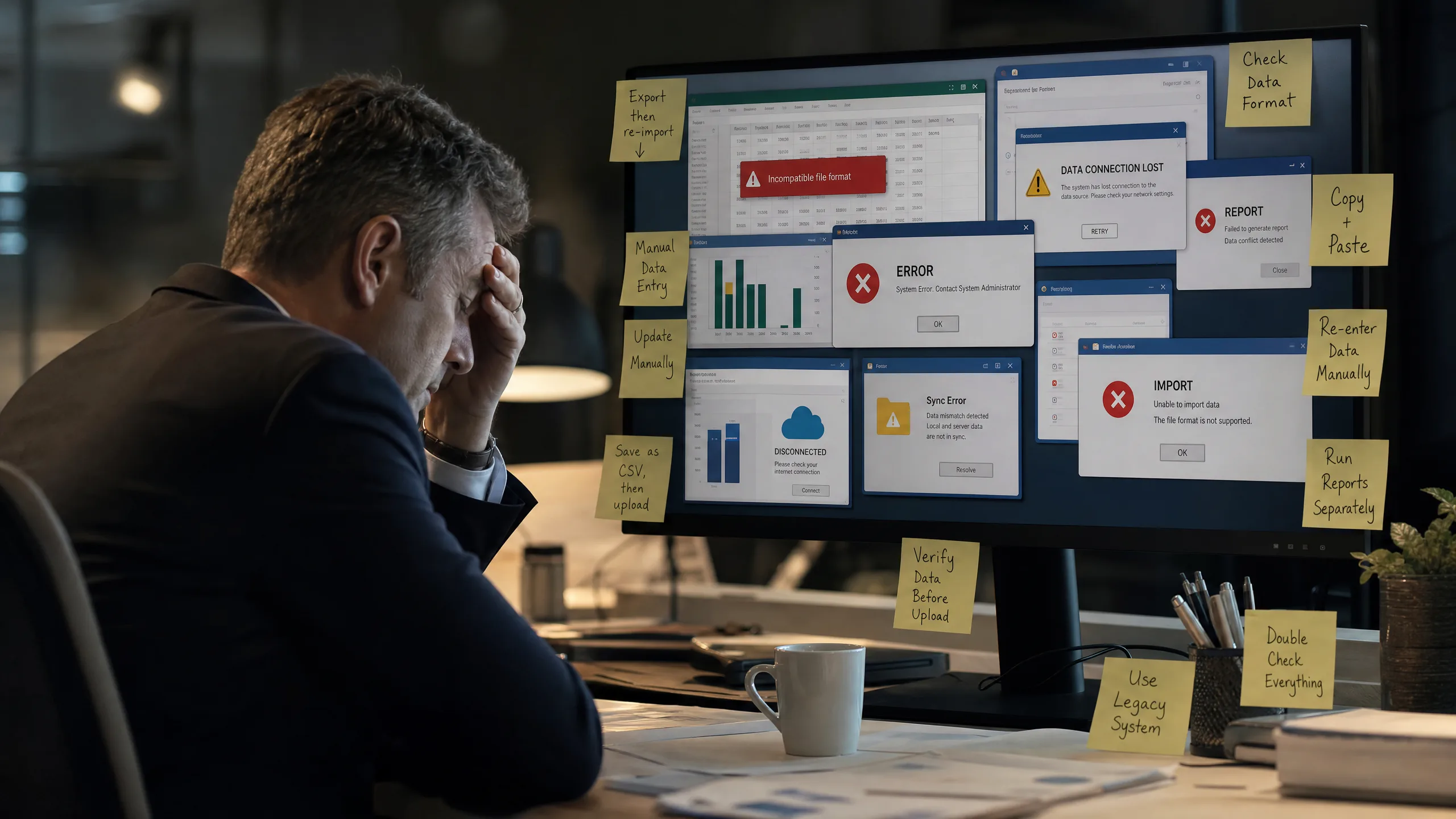
Every operational business has been through the cycle. A new software system is purchased with great expectations. The sales demo looked perfect. The feature list covered everything. Implementation begins — and reality sets in. The system doesn't quite match how you work. Workarounds appear. Spreadsheets return. Staff complain. And within a year, you're running the new system alongside the old processes it was supposed to replace.
This isn't a failure of your team or your implementation. It's a fundamental mismatch between generic software designed for average businesses and the specific operational workflows that define your industry.
The Workflow Mismatch Problem
Generic software is built around generic workflows. It assumes a standard process for handling orders, managing jobs, and coordinating teams. But operational businesses don't have standard workflows. A surveying company's order intake process is fundamentally different from a plumbing company's. An installer network's scheduling needs are nothing like a consulting firm's.
When the software's workflow doesn't match your actual workflow, one of two things happens:
You Adapt to the Software
Your team changes how they work to fit the system. Steps are added. Information is entered in fields it doesn't belong in. Processes become slower and more confusing. Staff fight the system instead of being helped by it.
You Work Around the Software
Staff develop workarounds — spreadsheets, emails, sticky notes — to handle the parts the system can't. You end up with a hybrid of the new system and the old manual processes, getting the disadvantages of both.
The Customisation Trap
"Don't worry," the vendor says, "we can customise it." And they can — at a cost. Every customisation requires consultants, takes weeks or months, and costs thousands. Simple changes that should take hours take weeks because they need to work within the constraints of the generic platform.
Adding a field: 2-4 weeks and $5,000+ in consulting fees
Changing a workflow: 1-3 months and $15,000+ in development
Adding an integration: 3-6 months and $30,000+ in project costs
Each upgrade risks breaking your customisations
You're locked into the vendor's development timeline
Your customisations are never quite right because they're constrained by the platform
After years of customisation, you've spent more than a custom system would have cost — and you still don't have exactly what you need.
Operational Rigidity
Generic systems impose rigidity on operational businesses that need flexibility. Your business changes — new services, new clients, new regulations, new market conditions. Each change requires your system to adapt. But generic systems resist change. They have fixed data models, fixed workflows, and fixed assumptions about how businesses operate.
The result is operational rigidity. You can't easily add a new service type because the system doesn't support it. You can't change your scheduling approach because the system enforces a specific model. You can't integrate with a new partner because the system's API doesn't expose what you need. Your software becomes a constraint on your business rather than an enabler.
Industry Complexity That Generic Systems Can't Handle
Operational industries have complexity that generic software vendors don't understand:
Surveying
Sites with multiple lots, plans, and job types. Builder relationships. Scheduling around weather and access. Delivery workflows for different plan types.
Installers
Multi-stage jobs spanning weeks. Material ordering and tracking. Customer availability windows. Quality checks and sign-offs. Retailer reporting requirements.
Field Services
Geographic scheduling optimisation. Skill-based job allocation. Real-time field updates. Equipment tracking. Compliance documentation.
Trade Operations
Quote-to-job conversion. Subcontractor coordination. Progress billing. Variation management. Site-specific safety requirements.
The Alternative: Purpose-Built Systems
The alternative to generic software isn't more generic software with better marketing. It's a system built specifically for your operational workflows — designed around how your business actually works, not how a software vendor thinks businesses should work.
Workflows that match your actual processes — no adaptation or workarounds needed
Data structures that reflect your business entities and relationships
Integrations built for your specific systems and partners
Changes made in days, not months — because there's no platform constraint
Performance optimised for your data volume and access patterns
Evolution driven by your business needs, not a vendor's product roadmap